


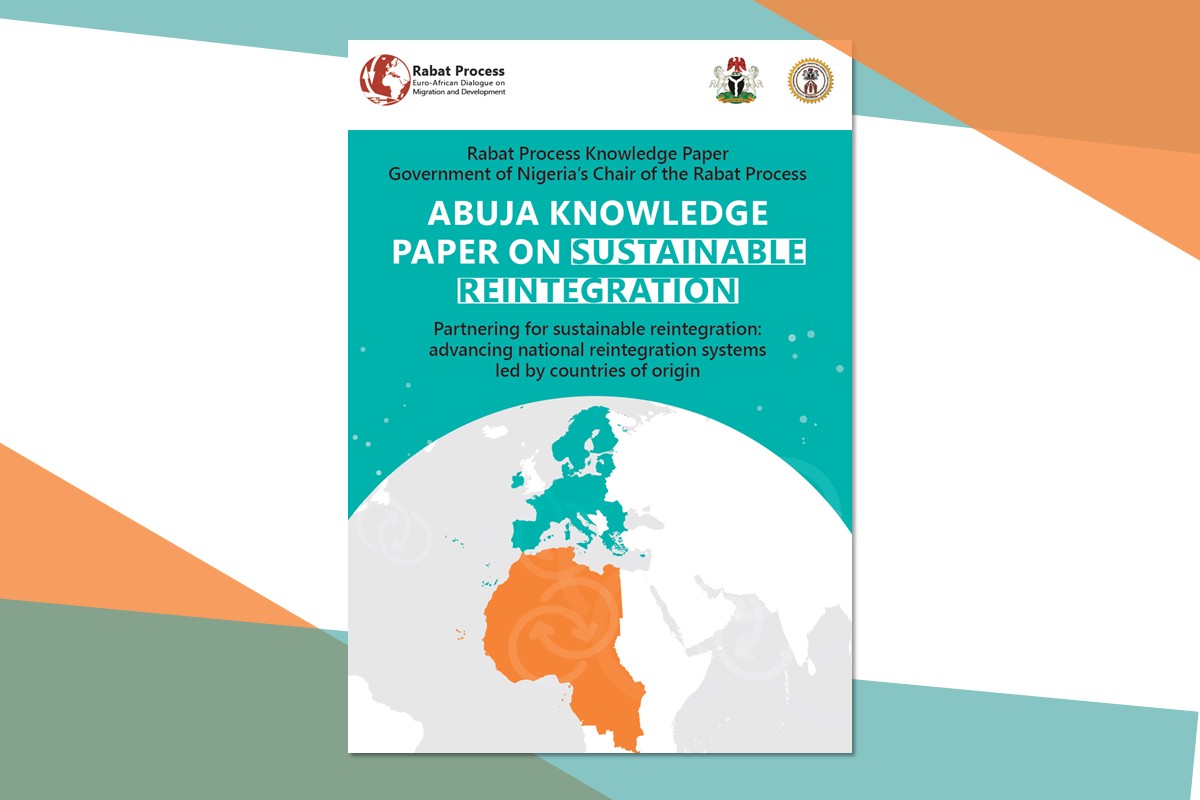
The "Abuja Knowledge Paper on Sustainable Reintegration. Partnering for sustainable reintegration: advancing national reintegration systems led by countries of origin" is a flagship Rabat Process publication developed under the Nigerian Chairmanship, in close cooperation with the International Centre for Migration Policy Development (ICMPD). It offers a clear and evidence based contribution to ongoing policy debates on sustainable reintegration across the Rabat Process region and beyond.
A strategic focus within the Rabat Process
Return and reintegration are key priorities in the Rabat Process, anchored in Area 5 of the Cádiz Action Plan (2023–2027). Over the last decade, significant return flows from North Africa and the Sahel have elevated reintegration as a national policy issue in many African countries of origin, prompting the development of strategies, coordination mechanisms, and institutional frameworks. The Abuja Knowledge Paper responds to this evolving context by analysing how partner countries can strengthen national reintegration governance in a sustainable, coherent, and development oriented manner.
Key messages
The Paper highlights five central ideas:
- Sustainable reintegration is a shared priority for countries of origin, transit, and destination and a core pillar of comprehensive, balanced migration governance.
- National ownership is a precondition for sustainable reintegration: development-oriented, country-of-origin-led reintegration systems can strengthen coherence, accountability, and long-term outcomes when anchored in national priorities and policies.
- Fragmented, short-term reintegration assistance limits impact, underscoring the need to shift toward coherent, system-based and longer-term approaches.
- External partners remain essential, not only for funding but as strategic partners in co-designing programmes, aligning interventions with national frameworks, and reinforcing coordination across institutions and borders.
- Transition toward country-of-origin-led systems must be gradual and context-specific, requiring sustained technical and financial support and continued dialogue among all stakeholders.
The analysis draws on a broad review of policies and programmes, consultations with by consultations with Rabat Process partner governments, international organisations, donors, research institutions, and field research in Nigeria, including interviews in Abuja and Lagos. The result is a balanced reflection on both the opportunities and limitations of country of origin led reintegration systems.
According to the Paper, sustainable reintegration depends on a series of interlinked elements such as political commitment, a clear policy framework, a lead coordinating institution, engagement of local authorities and civil society, accessible public services, and dedicated budget allocations. Because these elements take time to build, they require a phased and incremental approach, supported by strong partnerships.
The key role of external support
Most countries of origin are not yet able to fully lead reintegration efforts. The Paper therefore emphasises the need for continued partner support - financial, technical, and strategic - aligned with national frameworks and coordinated across donors. Gradual transition plans and joint implementation are key to making these systems effective and sustainable.
A practical tool for dialogue and policy development
While focused on the Rabat Process, the Paper’s findings are relevant to broader regional and global discussions on return and reintegration. It provides practical considerations for policymakers and practitioners working to strengthen reintegration governance within diverse national contexts.
Download the documents:
- The summary: The Abuja Knowledge Paper on Sustainable Reintegration - Executive summary
- The full publication: The Abuja Knowledge Paper on Sustainable Reintegration