

On 26 November 2025, the fourth meeting of the Network of National Focal Points (NFP) for Missing Migrants marked another key milestone in ongoing efforts to improve identification and international cooperation on missing migrant cases.
Organised by the International Committee of the Red Cross (ICRC) and co-convened by Switzerland and The Gambia with support from the Rabat Process Secretariat, this meeting brought together over 40 participants, including representatives from Rabat Process partner countries and from key international organisations. Building on priorities identified at the Thematic Meeting in Banjul in July 2025, this meeting placed a particular focus on the experiences of families of missing migrants, shedding light on persistent gaps in search, identification, and support mechanisms. It offered a space to reflect on these challenges and explore practical ways to strengthen coordinated, humane, and effective approaches.
Discussions underscored the need for clear entry points for families and stronger coordination among national authorities, law enforcement actors as well as international and civil society organisations, identifying concrete steps to reinforce both national and cross-border mechanisms.
Families’ voices: a call for clarity and support
The testimony of a Guinean woman who lost her sister at sea in 2023 exposed the serious challenges families encounter when seeking answers. She described the uncertainty about whom to contact, which procedures to follow, and how to initiate a search or identification process. Due to limited communication and coordination among national authorities - despite early witness reports and continuous support from a local civil society organisation - her family waited an entire year before her sister was identified.
Such prolonged uncertainty mirrors the experience of many families who face limited official support, a lack of accessible cross-border mechanisms, and the significant financial burden involved, which compounds their psychological distress and delay legal closure.
Beyond the emotional suffering, these tragedies strain already vulnerable households and communities that depend on the economic support of migrating relatives. The case underscores the urgent need for clear entry points for families, stronger cooperation between states, proactive involvement of diplomatic services, and improved psychosocial assistance for those affected.
Towards strengthened multistakeholder cooperation: bridging information gaps
The President of the organisation “Comitato 3Ottobre”, an organisation born after the 2013 Lampedusa shipwreck that caused more than 360 deaths, described years of working with families of missing migrants and highlighted the structural challenges that leave them without answers. He emphasised the lack of coordination between national authorities and stressed that these cases often involve several countries, requiring stronger international cooperation.
He also highlighted the need for a common data collection system and coordinated information-sharing between relevant authorities to enable effective identification processes. Despite volunteer-led progress, sustainable solutions require state leadership, harmonised data systems, cross-border cooperation, and better psychosocial support. Comitato 3 Ottobre has presented proposals to the European Parliament, stressing that meaningful progress depends on stronger engagement from authorities and formal partnerships with civil society actors.
Strengthening regional and international cooperation on Missing Migrants
INTERPOL, which participated in the Banjul Thematic Meeting and recently joined the Network, highlighted its critical role in supporting the location and identification of missing and deceased migrants through its global network of 196 member countries and their National Central Bureaux (NCBs). Tools include Yellow Notices, notices for unidentified bodies with biometric data, and the I-Familia DNA database, supported by expertise in disaster victim identification and forensics. Legal and political barriers remain, but INTERPOL is raising awareness and connecting NCBs with the Network of National Focal Points for Missing Migrants to improve coordination and support for missing migrant cases.
France, in its capacity as the current Chair of the Khartoum Process, and the Khartoum Process Secretariat highlighted growing efforts to address the issue of missing migrants, building on the Rabat Process. For the first time under the Khartoum Process, the 2025 Cairo Action Plan includes a dedicated section on missing migrants. Following a first webinar organised in September, both France and the Khartoum Process Secretariat emphasised the need to strengthen expertise, harmonise approaches, and learn from the Rabat Process, while exploring operational collaboration and potential joint activities to tackle cross-regional challenges like missing migrants.
Looking ahead
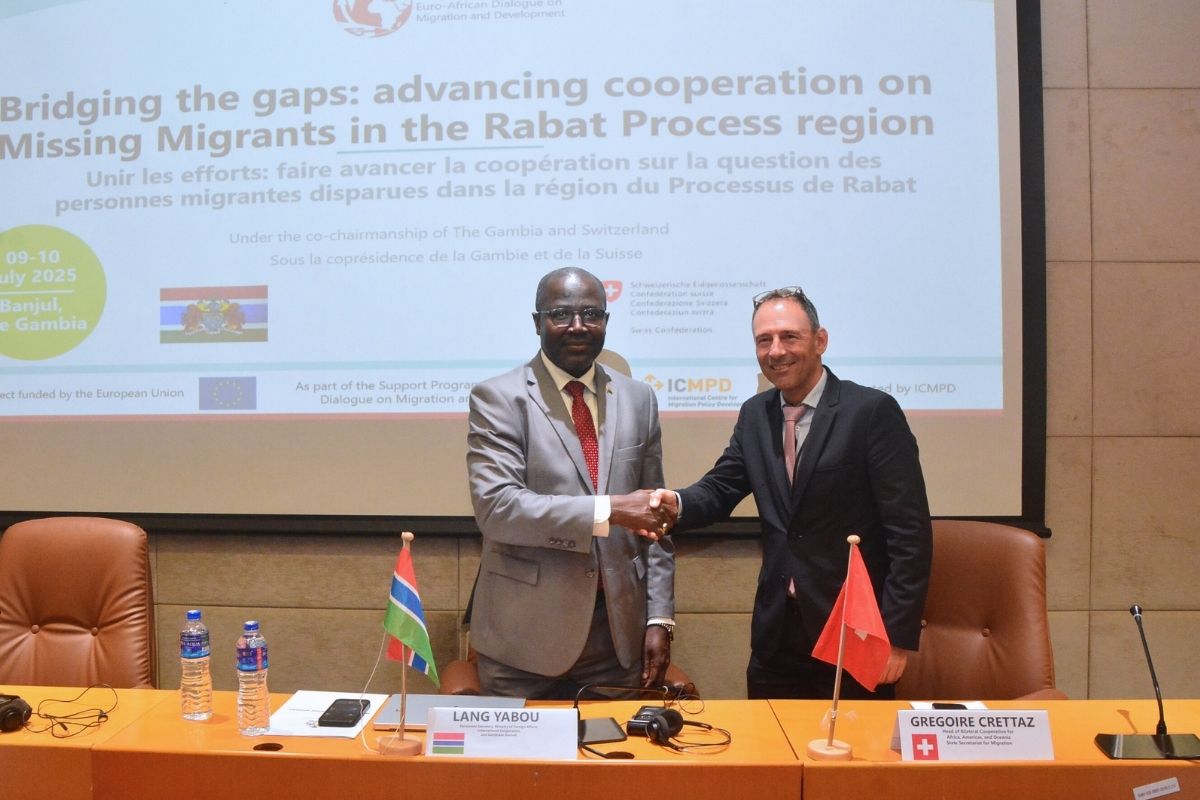
The Network has grown significantly since 2024 and achieved a key milestone with its first in-person Thematic Meeting in Banjul in July 2025, strengthening regional cooperation on missing migrants and promoting exchanges between the focal points. As of December 2025, 25 partner countries of the Rabat Process have officially designated a focal point. The outcomes and recommendations of this meeting provide the network with guidance.
This fourth meeting of the Network reaffirmed a shared commitment to continuing to build a more coordinated and family-centred approach to missing migrant cases. The insights gathered will inform future activities under the Rabat Process and the ongoing work of the Network of National Focal Points for Missing Migrants.
Looking ahead, Switzerland will assume the Rabat Process Chairmanship in 2026. Switzerland will be committed to maintaining the momentum created by the Banjul Thematic Meeting and supporting the further operationalisation of the Network, including the organisation of regular meetings. The next online exchange of the Network is scheduled for March 2026, under the future Swiss Chairmanship of the Rabat Process.