

On 25 March 2026, the 5th online meeting of the Network of National Focal Points for Missing Migrants brought together over 65 online participants, including government representatives, the ICRC, ICMPD, IOM, and the European Commission. The exchange was also extended to Red Cross and Red Crescent National Societies. Discussions highlighted shared challenges, practical field insights, and a renewed commitment to strengthening coordination and support to families searching for their loved ones. The issue of missing migrants remains both a humanitarian and human rights priority requiring coordinated efforts across borders.
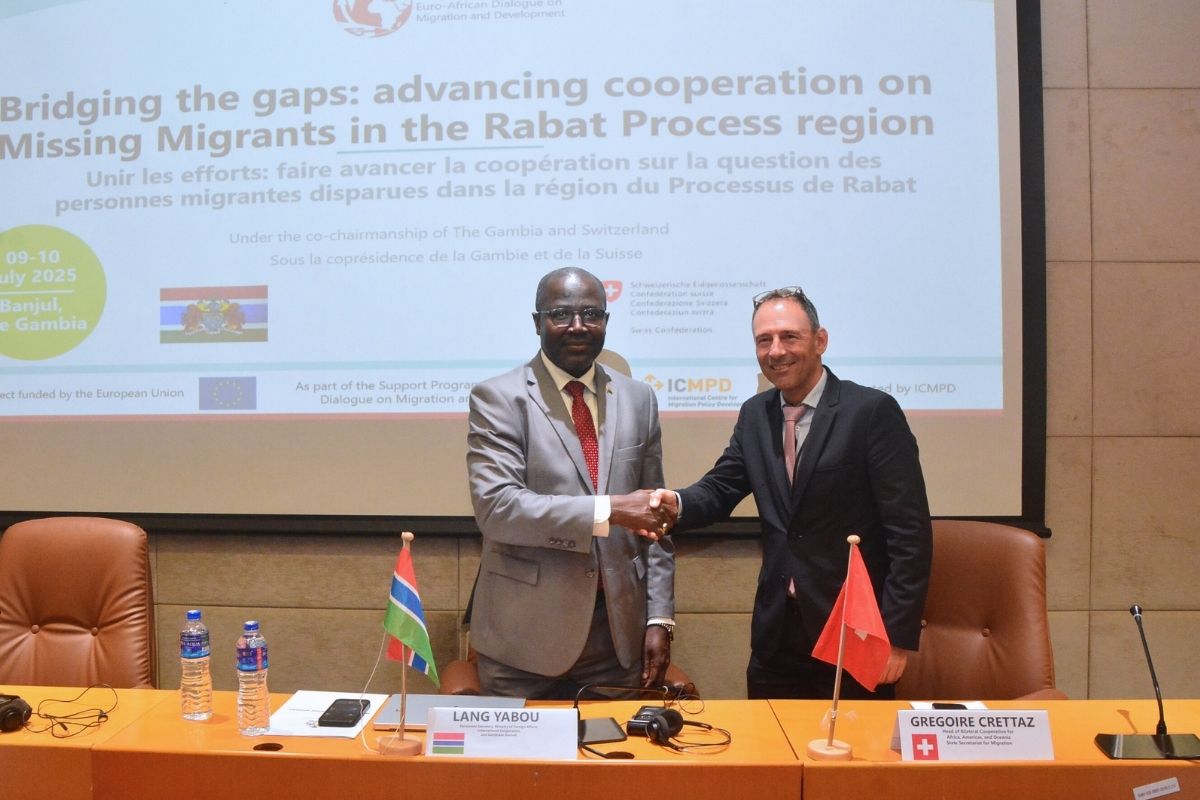
Since January 2026, Switzerland has assumed the Chairmanship of the Rabat Process for one year. During its tenure, Switzerland continues its long standing engagement on missing migrants within the Rabat Process, building on the momentum created by the first in-person Thematic meeting held in Banjul in July 2025. It has reaffirmed its commitment to ensure inclusivity and continuity with previous chairmanships, while seeking to introduce innovative approaches.
Understanding the Family Links Network
The meeting opened with a presentation from the ICRC’s Central Tracing Agency, which outlined the mandate and functioning of the Family Links Network. This global system brings together the ICRC, National Societies and the IFRC to prevent family separation, restore and maintain family contact, search for missing persons and support families throughout the tracing process.
The ICRC recalled that clarifying the fate and whereabouts of missing persons is primarily a responsibility of States. While the Red Cross and Red Crescent Movement plays an essential humanitarian role, the legal identification of deceased migrants and the sharing of official information rely on national authorities. In this context, a key message resonated throughout the session: effective cooperation between authorities and Red Cross actors is indispensable to resolving cases.
A new EU-supported initiative: the TRUST project
The European Commission (DG HOME) introduced the newly launched project TRUST – Transnational Response for the Unaccounted through Search and Tracing, with funding from the Asylum, Migration and Integration Fund (AMIF) and running from 2026 to 2028.
Implemented by the Italian, French, Portuguese and Swedish Red Cross Societies, with technical support from the ICRC, TRUST aims to strengthen the ability of institutional and civil society actors to identify, trace and respond to cases of missing migrants through targeted training, tools and knowledge sharing. The project further seeks to enhance families’ access to safe reporting mechanisms, timely and accurate information and psychosocial support, while reinforcing coordination among key stakeholders. The project will produce practical recommendations and a scalable model to inform both national and EU level policies on missing migrants.
The consortium expressed its intention to collaborate closely with the Rabat Process NFP Network and involve focal points in their upcoming workshops and exchanges.
Experience of the Gambia Red Cross Society
The Gambia Red Cross Society (GRCS) presented the scope of its operational work on restoring family links, illustrating how these activities unfold in practice across the country. Preventive efforts form a central pillar of the approach, with teams carrying out extensive community sensitisation campaigns in close collaboration with influential local and religious leaders. The GRCS also described its day to day case management and tracing work, which relies on regular follow ups, home visits and close coordination with the ICRC delegation in Dakar to progress cases effectively.
Support to migrants in distress is another key component of their activities, ranging from free phone services to transportation assistance for those stranded or returning home. The GRCS further provides basic psychosocial support to families who are waiting for news of missing loved ones. To broaden outreach, the National Society uses radio broadcasts, social media messaging, and a network of trained volunteers active across all seven regions of The Gambia. Throughout these efforts, the GRCS places a strong emphasis on data protection, ensuring the secure handling and transfer of all sensitive information.
The GRCS also shared its response to the December 2025 boat tragedy, in which a vessel carrying 250 migrants sank off the Gambian coast. With 102 survivors and 39 bodies recovered, more than 100 people remain unaccounted for. Through dedicated emergency support, the GRCS was able to conduct substantial community outreach and collect 44 tracing requests from affected families.
A renewed commitment to coordinated humanitarian action
In closing the meeting, The Gambia emphasised the importance of enhancing coordination among authorities, National Societies and international partners to strengthen collective responses. Sustained information sharing, capacity building and joint action remain essential to better support families searching for missing migrants.
Overall, the discussions reflected a strong, shared commitment across the Network to uphold the dignity of migrants and their families and to ensure that no missing person is forgotten.
Looking ahead
The Network has grown significantly since 2024 and achieved a key milestone with its first in-person Thematic Meeting in Banjul in July 2025, strengthening regional cooperation on missing migrants and fostering exchanges among the focal points. As of March 2026, 26 partner countries of the Rabat Process have officially designated a focal point.
Building on this momentum, the Network will convene for a second in-person meeting of focal points in Geneva on 24-25 June 2026. This gathering will provide a valuable opportunity to further consolidate the network, strengthen collaboration and advance regional cooperation on missing migrants in the Rabat Process region. Thanks to dedicated funding from Switzerland, the meeting will be co chaired by Switzerland and The Gambia, with the support of the ICRC and the Rabat Process Secretariat.